
You can spend weeks building a training program, deliver it perfectly, and still watch the whole thing evaporate a few months later. The slides were sharp. The facilitator was on. Everyone nodded in all the right places.
And then… poof.
The training drifts off into the great corporate cloud of forgotten things, somewhere between last year’s kickoff deck and that Teams recording nobody has opened since. It’s tempting to blame the content, the Learning Management System or the employees, but there’s a question hiding under all of it: what if the way we present information is the thing making it so hard to remember?
That’s where visual learning gets interesting.
First, Debunk the “Visual Learner” Myth
You’ve probably heard about these categories: visual, auditory and kinesthetic learners. It sounds tidy. Match the person to the style, sprinkle in the right slides, and knowledge sticks. Right?
Not quite. Decades in, researchers have found virtually no evidence that matching instruction to someone’s supposed learning style actually improves what they retain. So before you start sorting 5,000 employees into visual, auditory, and hands-on buckets, here’s a more useful question:
How do we make the important stuff easier for everyone to process?
Why Visual Learning Gives Your Brain Something to Hang Onto
Psychologist Allan Paivio’s dual coding theory is the cleanest way to think about this. A few decades ago, he found out our brain runs information through two systems, one verbal and one visual. When related words and images show up together, the idea gets encoded in more than one place. And when visual information is layered on top of the words, retention beats what you get from words alone.
Imagine explaining a messy, multi-step process using nothing but sentences.
Now imagine the same thing like this:
Step 1, Step 2, Decision, Outcome.
Suddenly you can see how it all connects.

The visual didn’t replace the explanation: it gave the learner a second handle. That’s the real opportunity with visual learning: you’re not decorating the training, you’re giving the learner a stickier learning experience.
And the research backs it up. A 2018 study in Theory and Research in Education found that learners who processed visual information alongside spoken information retained roughly twice as much as those given words alone. Twice.
This is why visual learning has become a backbone of modern education, the same instinct great teachers have leaned on in the classroom for years. And in a 5,000-person company, the stakes are higher than a classroom ever faces. When everyone actually walks away on the same page, it shows up everywhere that matters: faster alignment, a better employee experience, and yes, the revenue that follows both. Clarity isn’t a nice-to-have. It’s a business lever.
So What Does This Look Like at Work?
Here’s where it gets more interesting than dropping a stock photo of a grinning coworker next to a bullet point.
Picture a strategy offsite.
Six hours of priorities, trade-offs, big decisions. People take notes. Someone records it. Someone else swears they’ll “send a recap.”
Three weeks later, everyone remembers that there was an offsite.
The details? Blurry.
Now imagine those same ideas taking shape as a visual map while the conversation happens. Priorities line up. Connections appear. Decisions get pinned down. That’s visual storytelling for corporate meetings in action. The conversation finally has a picture, and people reference it instead of digging through 47 slides and a two-hour recording.

The same instinct scales across your whole learning program:
- Onboarding: turn a tangled employee journey into something people can actually see.
- Policy training: give the rules a visual structure instead of another wall of text.
- Product training: show how features connect to real customer problems.
- Remote teams: lean on virtual team visualization to give distributed folks one shared reference point when nobody’s near a whiteboard.
- Strategy sessions: capture decisions and priorities as they emerge, live.
Strong visual communications aren’t about making everything look like a picture book. They’re about making the relationships between ideas easy to see.
You’ve Got More Visual Options Than You Think
A visual doesn’t have to mean one person at the front of the room with a marker.
Sometimes the best move is animation.
A dense process can become one of those animated infographics that reveals itself one clean step at a time. A culture message can land as business animation with a little more personality than your average corporate slide. And data-heavy content can use motion graphics to steer the eye toward what actually matters.
And when the learning is happening live, there’s another option:
Draw it as it happens.
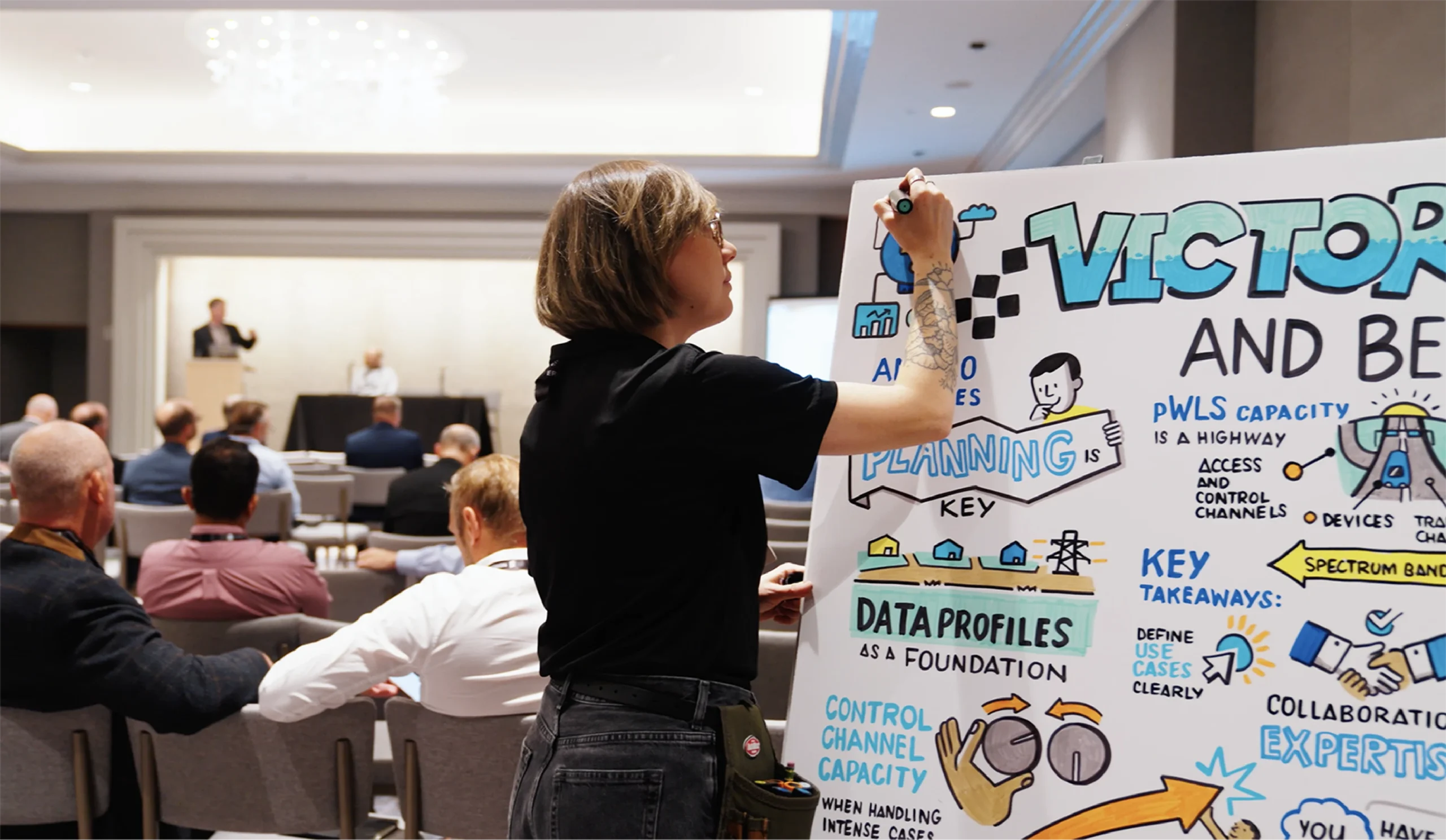
Visual note-taking and virtual graphic recording capture ideas in real time (in the room or on the screen), so your audience literally watches the thinking take shape. That’s the magic of good visual storytelling: someone says something important, an artist hears it, translates it, and suddenly the idea is sitting right there in front of everyone.
“Wait, that’s exactly what I meant.”
That hits differently than watching bullet number six fade onto a slide. If you’re curious why that reaction is so consistent, the psychology of graphic recording digs into what makes live visual thinking so sticky.
How to Build Visuals Into Your Next Program
You don’t need to rebuild your curriculum overnight. Start where the stakes (and the confusion) run highest:
- Anchor your next big meeting with a live artist. Bringing live sketch artists into a conference turns a passive audience into an engaged one and sends everyone home with a shared image.
- Give your key messages a visual aid. Even one strong image can reframe an entire talk: here’s how a visual aid transforms a presentation.
- Match the format to the moment. From graphic recording to animation, the right visual communication format depends on your goal, your audience, and your setting.
- When in doubt, bring in a pro. There are plenty of good reasons to hire a graphic recorder, and nearly all of them come down to retention.
The organizations that win at knowledge retention aren’t the ones with the most content. They’re the ones who make their content impossible to forget. Visual learning is how you get there, not by labeling people, but by working with the way every brain is already wired. Your next training program is a chance to prove it. Make it something people can genuinely see, and watch how much longer it stays with them.
Do you want to explore how visual learning can enhance your corporate training? We’ll be happy to walk you through it.